EXHIBITIONS


May 29, 2026 – July 2, 2027
15 zł (regular), 10 zł (reduced), 1 zł on Thursdays
Look, no hands! How Bicycles Change Warsaw

For 150 years, bicycle has occupied a paradoxical place in the history of Warsaw—it is one of the most transformative yet consistently underestimated inventions. From the perspective of the history of technology, it appears to be little more than a transitional stage—a link between the era of walking and horse-drawn transport and the dominance of the internal combustion engine. The invention of a bicycle may have inspired enthusiasm in the late nineteenth century but seems unlikely to excite people today. It is slower, incapable of carrying heavy loads and designed essentially for a single person. It leaves its rider exposed to the rain, too. And yet, it is precisely this simplicity that has allowed bicycle to emerge time and again—even today—as a tool for reimagining and reforming the city.
The curators of the exhibition Look, no hands! How Bicycles Change Warsaw set out to explore this paradox, presenting the bicycle not merely as a means of transport but as a technology that shapes and transforms social practices, bodily experience, and the urban imagination. Cycling, in turn, is examined as both a historical and a contemporary phenomenon—a practice that has assumed different, often contradictory meanings at different moments in time and has been associated with competing visions of modernity. The exhibition explores themes such as mobility as a cultural experience, emancipation, and cycling as an element of the city’s material culture and as a political phenomenon. Look, no hands! How Bicycles Change Warsaw exhibition is available for viewing at the Wola Museum, a branch of the Museum of Warsaw, from 29 May 2026 to 2 July 2027.
The origins of the bicycle and the rise of cycling
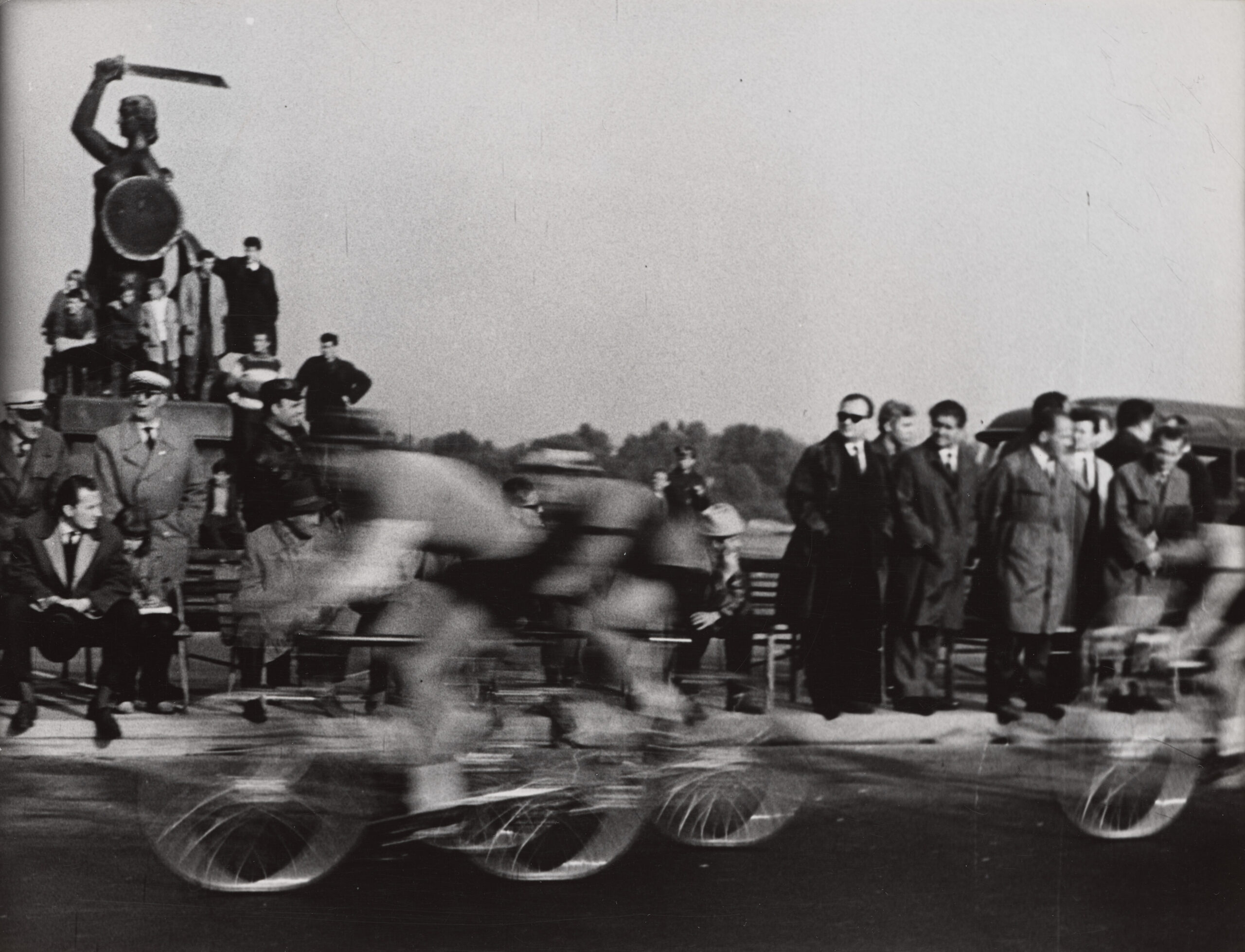
Cyclists riding along the Kościuszko Coast during the Peace Race, Edward Hartwig, 1960s, collection of the Museum of Warsaw
Bicycles first appeared in Warsaw in the nineteenth century. The earliest rides took place in the 1860s on imported or locally manufactured bicycles. The real breakthrough, however, came after 1886, when the Warsaw Cyclists’ Society was founded and the “safety bicycle”—essentially the type of bicycle we know today—was invented in England.
The early years of cycling also witnessed the emergence of specialist sports journalism. In the exhibition, we present issues of Cyklista (The Cyclist), Koło (The Wheel), Kolarz, Wioślarz i Łyżwiarz (Cyclist, Rower and Skater), and Warszawska Gazeta Sportowa (Warsaw Sports Gazette), whose pages not only reported on the rapidly developing world of competitive cycling but also explored questions of health and ideology. Visitors will also admire a neckerchief associated with the 1950 Peace Race, documenting the culture of sports fandom and the range of memorabilia accompanying one of the most important sporting events in the Eastern Bloc.
The exhibition also explores cycling through film, such as Magical Bicycle, directed by Silik Sternfeld from a screenplay by Jerzy Suszko and Bohdan Tomaszewski. Set partly in Warsaw during international cycling races, the film combines sports drama with social commentary. Also on display are photographs by Leonard Jabrzemski, donated to the Museum of Warsaw in the 1970s, documenting bicycle races held on the streets of the capital during the years of postwar reconstruction.
Bicycle as a tool of emancipation
One of the exhibition’s central themes is emancipation. At various moments in history, the bicycle has served as a means of expanding the autonomy of workers, women, children, and migrants. It enabled independent mobility, reshaped the relationship between work and leisure, between the private and the public sphere, and offered people a greater sense of freedom. The history of cycling is therefore closely intertwined with the history of social aspirations—across class, gender, and generations—and with changing ways of life.
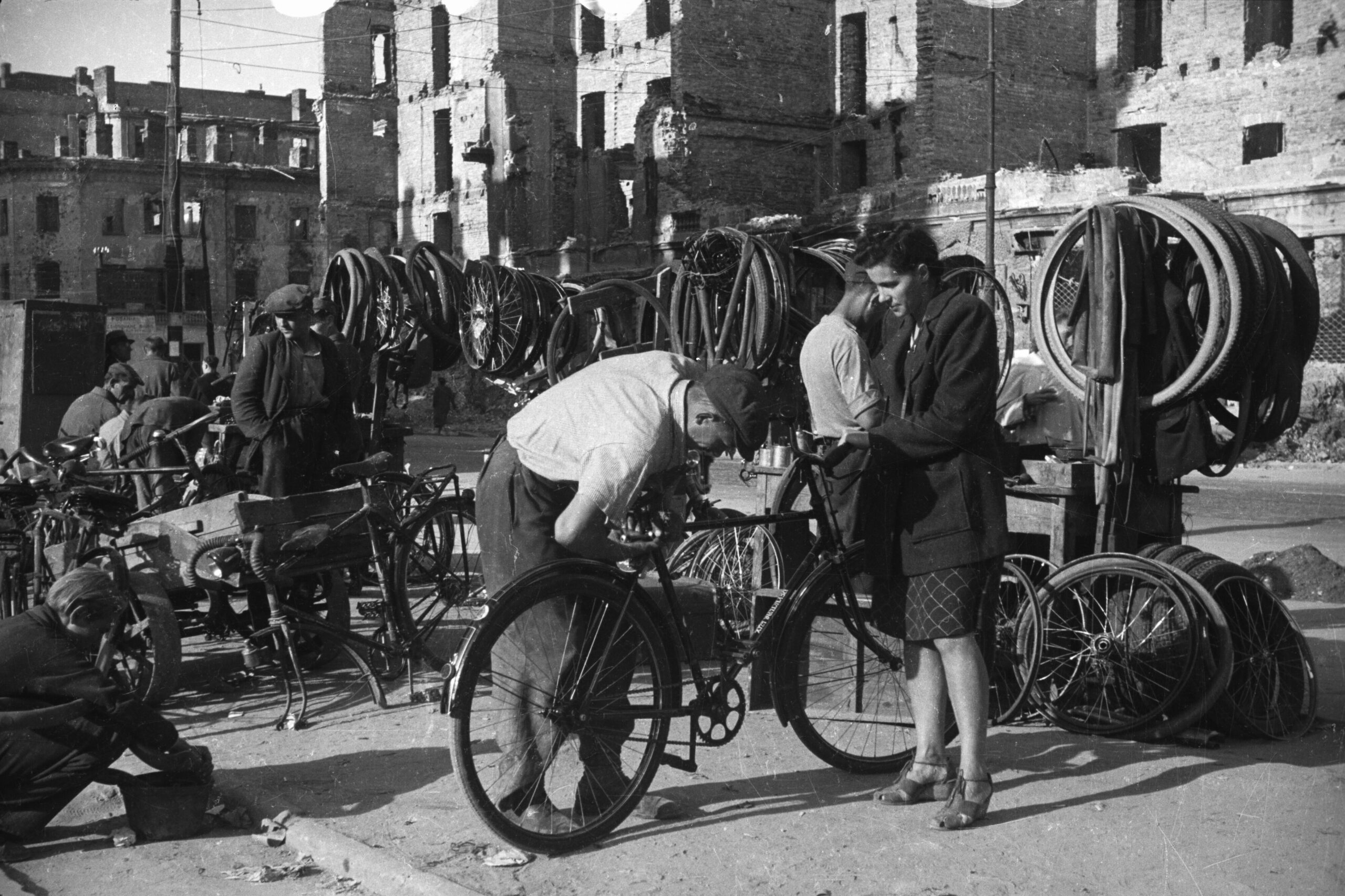
Maria Chrząszczowa at a bicycle workshop and sales stand on Marszałkowska Street, Zofia Chomętowska, 1945, collection of the Museum of Warsaw
The exhibition features photographs of Karolina Kocięcka and Maria Skłodowska-Curie on bicycles, illustrating the bicycle’s role as an instrument of social transformation at the turn of the twentieth century. Kocięcka, a celebrated record-holder and one of the first Polish sportswomen known by name, embodied women’s emancipation through sport and public activity. Skłodowska-Curie represents a parallel struggle for independence in the sphere of science, where international mobility and an academic career became defining elements of women’s modern identity.
Also on display is a photo essay by Wiesław Prażuch devoted to rural postwomen, documenting postal services in the Polish countryside during the 1950s. In this context, the bicycle was an essential working tool, enabling efficient travel to remote villages, often scattered over a large area. The presence of women in this profession reflected the ideals of socialist emancipation and affirmed their right to pursue occupations requiring independence and mobility.
Warsaw’s bicycle industry before 1939
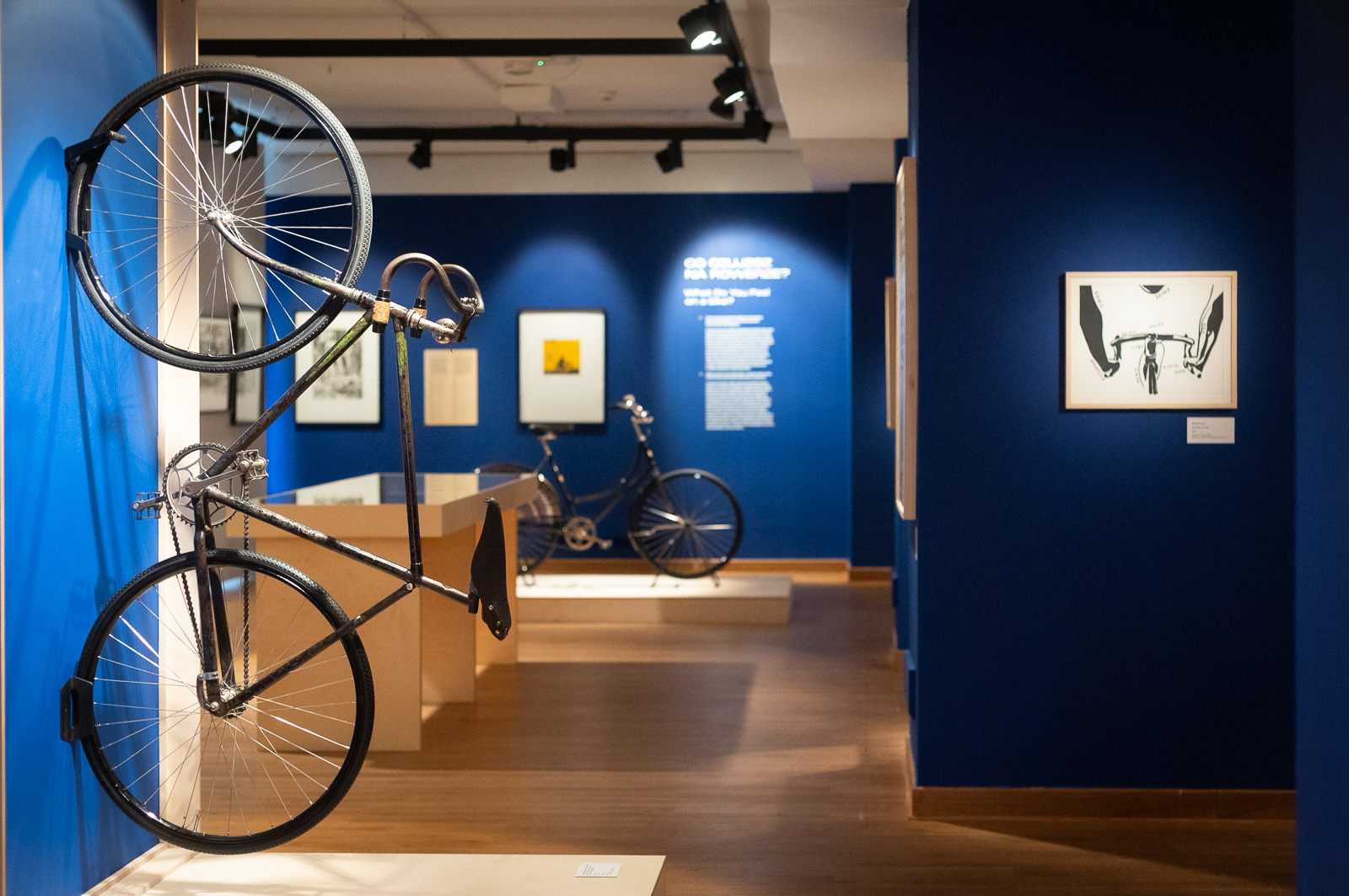
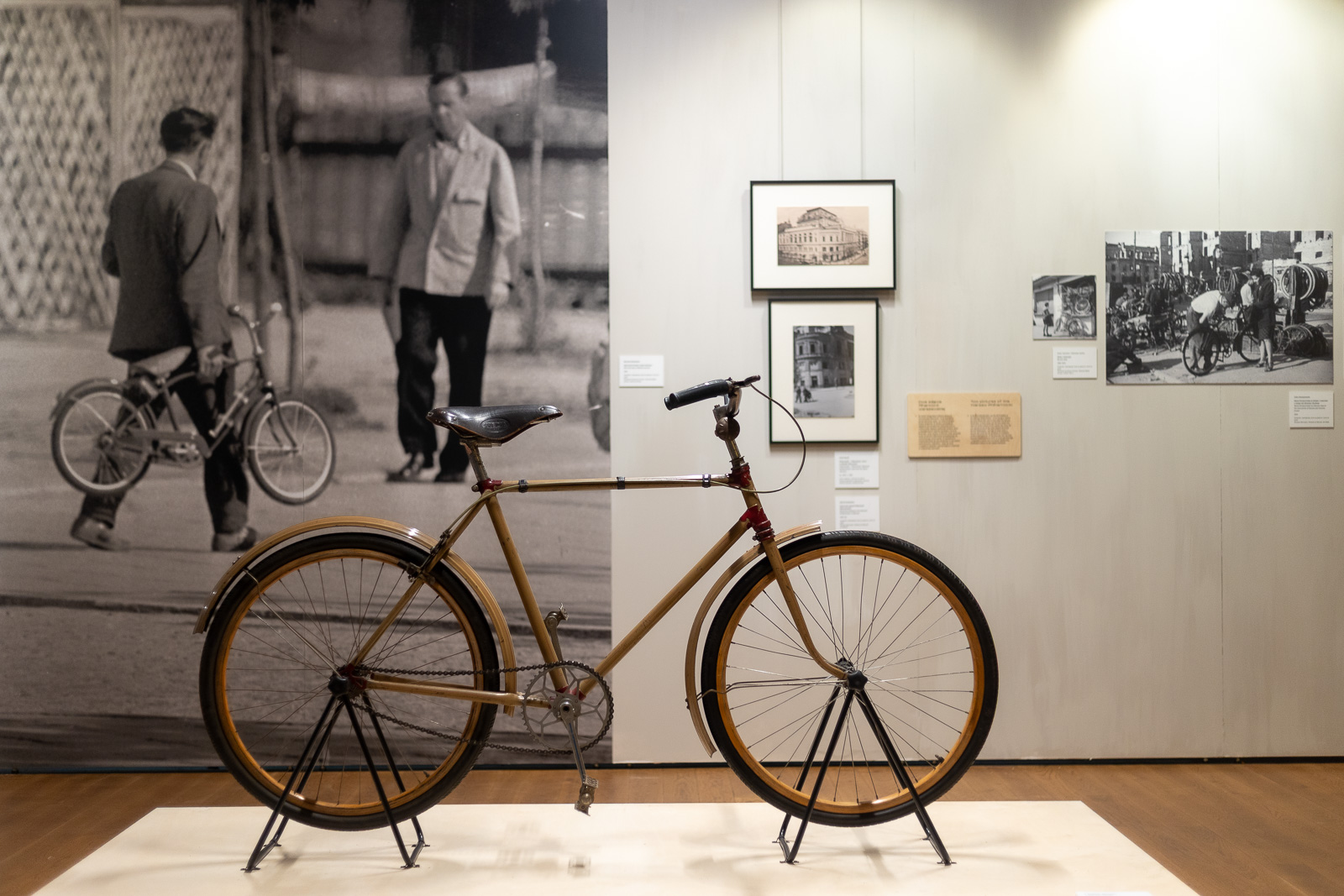
The bicycle can also be understood as part of the city’s material culture—a product of manufacturing, distribution, and repair. Its history connects everyday cycling practices with Warsaw’s craft traditions and industrial production, particularly in the Wola district. The story of the bicycle’s social significance leads from local workshops and factories to streets, cycling routes, and the city’s informal mobility infrastructure. The exhibition presents maps of Warsaw’s bicycle industry, tracing the development of manufacturing before and after the First World War, alongside bicycles themselves, including outstanding examples of local craftsmanship, such as models produced by A. Kamiński’s Warsaw factory.
Body and the senses
Another important theme explored in the exhibition is mobility as a bodily and sensory experience, as well as a cultural one. Cycling changes not only the way people move through the city and relate to one another, but also their relationship with time and space. It allows distances to be covered more quickly than on foot while keeping the rider’s senses closely connected to the city’s material reality—its smells, sounds, and rhythms. In this sense, cycling can be understood as a distinctive mode of perception: a way of seeing and experiencing the urban environment. Simply visiting the exhibition is not enough—it is worth riding to the Wola Museum on your own bicycle or a public bike and comparing the exhibition’s themes with your own lived experience.
Bicycle as a means of communication
Since its earliest days, the bicycle has served as a vehicle for couriers. First came newspaper delivery boys, then, at times, messengers for resistance movements during the German occupation and workers’ strikes, and, at the turn of the twenty-first century, the distinctive subculture of fixed-gear bicycle couriers weaving between the glass office towers of Warsaw.
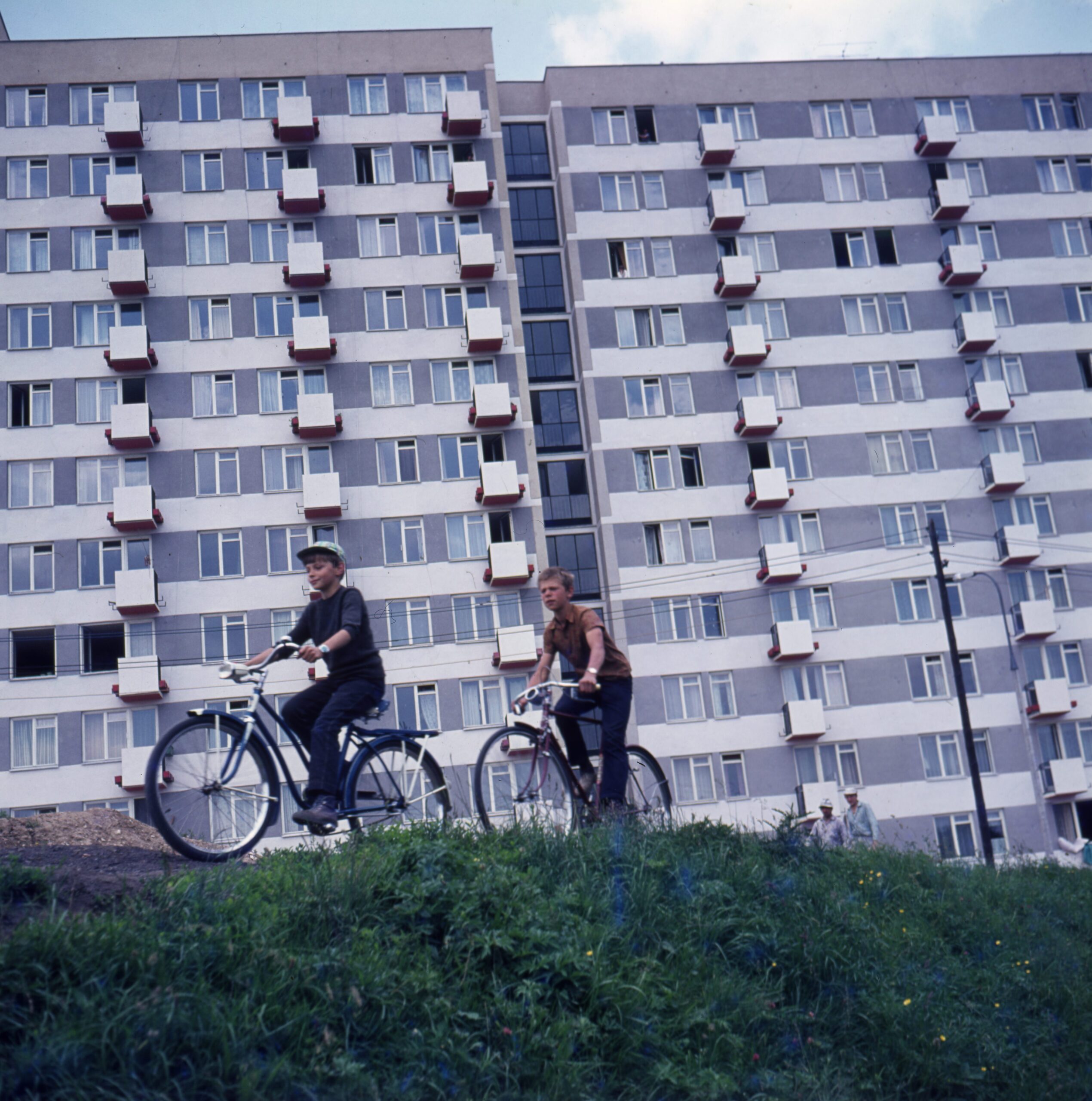
Children on Bicycles, Romuald Broniarek, Służewiec, 1971, from the KARTA Center’s collection
Today’s cycling community also includes food delivery couriers. Their everyday work reflects the logic of what has been described as patchwork capitalism—a system shaped by fragmented forms of regulation, in which the promised flexibility of delivery work often serves as a euphemism for insecurity. In this context, the bicycle becomes a tool of intensive, often long-hour labour, where responsibility for safety, health, and income rests largely with the couriers themselves, many of whom have migration backgrounds. Seen in this light, the bicycle ceases to be merely a means of personal expression or recreation; it becomes a tool for navigating a system that redefines the relationship between the body, labour, and urban space.
A vital element of change
Finally, cycling is also a political phenomenon. In recent decades, bicycle has returned to the centre of debates about the future of Warsaw. It has become part of wider discussions on environmental sustainability, access to public services, and the scale and character of the city in which we want to live. The activities of urban grassroots movements, new transport policies, and alternative visions of urban planning have made the bicycle not only a symbol of change but also an active force shaping the contemporary metropolis.
Seen against this broad backdrop of facts, meanings, and uses associated with the bicycle, the No Hands exhibition title can be understood in several ways. It camn signify risk, movement, and the loss of stability, but also the balance that can only be achieved while in motion. Riding with no hands is a gesture of childhood courage, youthful daring, and the confidence to challenge the established rules. Once we gather enough speed, a bicycle can take us a very long way.
-

- photo by Tomek Kaczor

-

- photo by Tomek Kaczor

-

- photo by Tomek Kaczor

-

- photo by Tomek Kaczor
-

- photo by Tomek Kaczor
-

- photo by Tomek Kaczor

-

- photo by Tomek Kaczor

-

- photo by Tomek Kaczor

-

- photo by Tomek Kaczor

COLOPHON
curators Piotr Kubkowski, Konrad Schiller
production Michał Tański
architectural and graphic design Studio Robot (Krzysztof Czajka, Łukasz Wysoczyński, Zofia Janina Borysiewicz – współpraca graficzna)
typography system for the Museum of Warsaw exhibitions Anna Światłowska
accompanying programme Konrad Schiller, Piotr Kubkowski, Klaudia Jaraszek, Henryk Kwiatek (Galeria TOR/Nowe Dynasy), Piotr Brama, Towarzystwo Krajoznawcze Krajobraz
educational programme Katarzyna Żukowska
cooperation Henryk Kwiatek, Łukasz Kubacki, Kseniya Homel, Nextbike – operator Veturilo, Antymateria, Urvis Bike, Maria Mencwel, Michał Mańkowski, Muzeum Sportu i Turystyki, Towarzystwo Krajoznawcze Krajobraz, Kuchnia Konfliktu, Zarząd Dróg Miejskich Urzędu m.st. Warszawa
loans from institutions and private individuals Muzeum Warszawy, Muzeum Narodowe w Warszawie, Zachęta Narodowa Galeria Sztuki, Muzeum Sportu i Turystyki, Muzeum Narodowe w Krakowie, Narodowe Archiwum Cyfrowe, Biblioteka Narodowa/Polona, Ośrodek Karta, Nextbike – operator Veturilo, Antymateria, Urvis Bike, Kwiaciarnia Grafiki, Galeria TOR/Nowe Dynasy, Łukasz Kubacki, Michał Mańkowski, Wytwórnia Filmów Dokumentalnych i Fabularnych, Zielone Mazowsze, Tomasz Kaczor, Ewa Breymeyer-Darska, Biblioteka Uniwersytetu Warszawskiego, Biblioteka Uniwersytetu Jagiellońskiego, Maria Mencwel, Anna Libera
reproductions Biblioteka Narodowa (Polona.pl), Narodowe Archiwum Cyfrowe, Fundacja Ośrodka KARTA, Biblioteka Uniwersytetu Warszawskiego, Muzeum Warszawy
exhibition production Piotr Lipiński (koordynacja), Michał Bogumił, Zofia Cur, Ksenia Góreczna, Paweł Grochowalski, Krzysztof Kwiatkowski, Artur Miniewicz, Katarzyna Radecka, Tomasz Raubo, Leszek Sokołowski, Mariusz Stawski, Filip Wielechowski-Olszak, Adam Wrzosek, Aleksandra Złotowska
conservation Piotr Kaczkiełło, Anna Konopko, Katarzyna Lesiakowska-Tofil, Igor Nowak, Karolina Nowicka, Piotr Popławski
external loans Janusz Kurczak
internal loans Aleksandra Lis, Dawid Łukasiak, Małgorzata Oliwińska, Dorota Parszewska, Joanna Rykiel, Zuzanna Sieroszewska-Rolewicz, Filip Żelewski, Tomasz Lewandowski
coordination of digitization Mikołaj Kalina
digitization Adrian Czechowski, Eliza Kowalska-Małek, Michał Matyjaszewski, Anna Sulej
editing Katarzyna Głowińska
translation Aleksandra Szymczyk
poster design Anna Światłowska
communications and marketing Anna Dobrowolska-Balcerzak, Agata Fijałkowska, Agata Fronczyk, Daniel Karwowski, Anna Ładna, Jowita Purzycka, Nela Sobieszczańska, Karina Dąbska, Olga Gaertner, Maria Alicja Włodarska
installation Gustaw Maj (Bardaszka DYI)
design Maria Mencwel
realisation Sesme Studio Dawid Krysztofiak
partners Antymateria, Nextbike – operator Veturilo
Education Partner of the Museum of Warsaw PGE Polish Energy Group
media patrons TVP Sport, Wyborcza.pl, Radio Nowy Świat, Notes Na 6 Tygodni, Kultura Kolarska